Peptides for Weight Loss: The Complete Science-Based Guide (2026)
Ten years ago, losing 20% of your body weight without surgery was practically impossible.
Today there are clinical trials with thousands of participants who achieve it on average.
The reason? A group of molecules called peptides, which mimic hormones the body itself produces after eating.
The problem is that a lot of incomplete information circulates around this news. Social media mixes approved medicines with compounds that have only been tested in mice, figures get quoted without context, and almost nobody talks about what happens when treatment stops.
That's why we wrote this guide.
Here you'll find what the published studies say, with exact figures and the references at the end so you can verify everything.
In this guide you'll learn:
- What a peptide is and why some affect appetite and weight.
- How the three key hormones work: GLP-1, GIP and glucagon.
- What results each peptide achieved in the most important clinical trials.
- What the most common side effects are, with real percentages.
- What happens to weight when treatment is stopped.
- Which compounds have solid evidence and which don't yet.
- Where research is heading.
Let's get started.
Contents
- Chapter 1: What is a peptide
- Chapter 2: The three hormones that control appetite
- Chapter 3: A brief history of weight-loss peptides
- Chapter 4: Semaglutide, the GLP-1 agonist
- Chapter 5: Tirzepatide, the dual agonist
- Chapter 6: Retatrutide, the triple agonist
- Chapter 7: Cagrilintide and the amylin pathway
- Chapter 8: Tesamorelin and other peptides mentioned online
- Chapter 9: The results, side by side
- Chapter 10: Side effects
- Chapter 11: What happens when treatment is stopped
- Chapter 12: Approved medicines and research peptides
- Chapter 13: The future of research
Chapter 1: What is a peptide
A peptide is a short chain of amino acids.
Amino acids are the same building blocks that make up proteins. The difference is size: a protein has hundreds or thousands of amino acids, while a peptide usually has between 2 and 50.
Your body makes hundreds of different peptides. Many of them work as messengers: they're released in one organ, travel through the blood and give an instruction to another organ.
Insulin, for example, is a peptide (technically a 51-amino-acid peptide hormone). So are several hormones the gut releases when you eat, which tell the brain and pancreas that food has arrived.
Those gut hormones are the basis of almost all peptides studied for weight management.
Why not just use the natural hormones?
Because they last very briefly.
Natural GLP-1, for example, disappears from the blood within a couple of minutes: an enzyme called DPP-4 breaks it down almost immediately. A hormone that lasts two minutes is useless as a treatment.
So researchers modified its structure. They changed some amino acids so the enzyme doesn't recognize them and added a fatty-acid "tail" that binds to albumin in the blood. The result is molecules that last days instead of minutes.
Semaglutide, for example, has a half-life of about one week. That's why trials give it once a week [1].
Key point: the peptides studied for weight are mostly modified versions of natural gut hormones, designed to last days instead of minutes.
Chapter 2: The three hormones that control appetite
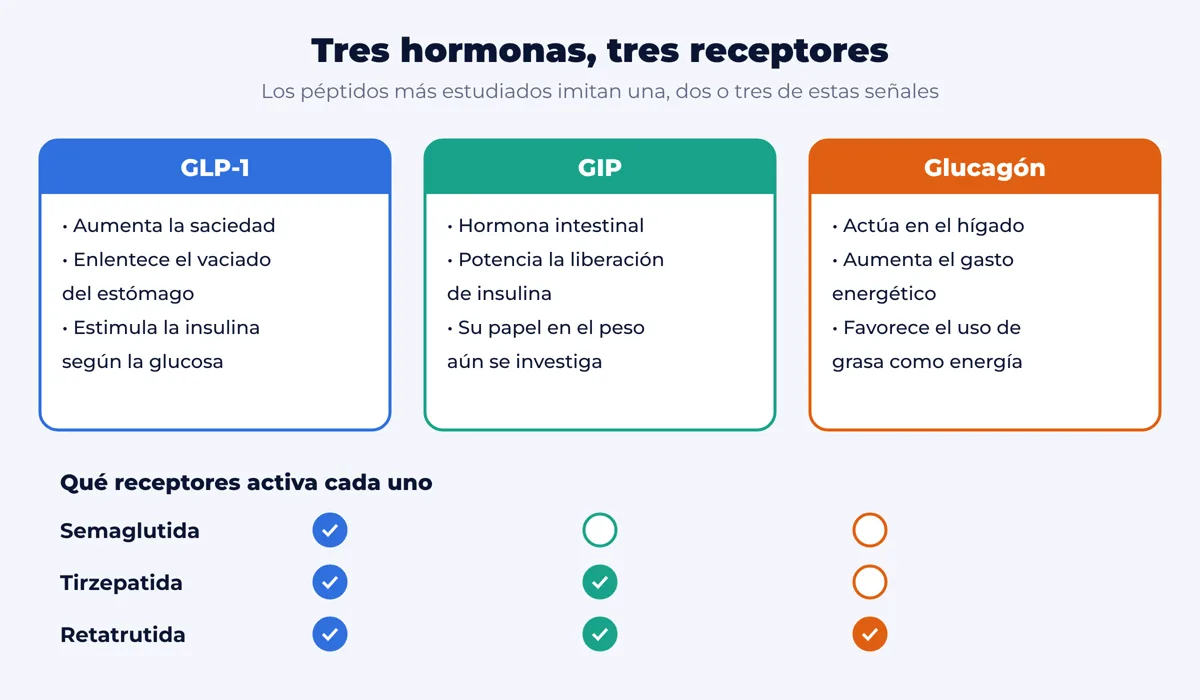
To understand the study results, you need to know three hormones. Each peptide we'll cover activates one, two or all three.
GLP-1: the satiety signal
Glucagon-like peptide-1 (GLP-1) is released by cells in the gut when food arrives. It has three main effects:
- In the brain: it acts on the centers that regulate appetite and increases the feeling of fullness.
- In the stomach: it slows emptying, so food stays longer and the feeling of fullness lasts longer.
- In the pancreas: it stimulates insulin release, but only when glucose is high.
That last detail matters. Because the effect depends on glucose, the risk of hypoglycemia in people without diabetes is low.
GIP: the missing partner
Glucose-dependent insulinotropic polypeptide (GIP) is the other major gut hormone. It also boosts insulin release.
For years GIP was thought to be useless for weight loss. There was even debate about whether it should be blocked rather than activated. But when it was combined with GLP-1 in a single molecule, weight loss was clearly greater than with GLP-1 alone [3][4].
Why this happens is still being researched. Its exact role in weight is one of the most interesting open questions in the field.
Glucagon: the energy-expenditure accelerator
Glucagon is best known for raising blood glucose. But it does other things too: it acts on the liver, increases energy expenditure and favors the use of fat as fuel.
The idea behind the latest-generation peptides is to harness those effects and offset the rise in glucose with the action of GLP-1. That's the logic behind triple agonists like retatrutide.
Key point: GLP-1 reduces appetite, GIP enhances its effect and glucagon increases energy expenditure. The more of these receptors a peptide activates, the greater the weight loss has been in trials.
Chapter 3: A brief history of weight-loss peptides
This story starts in an unexpected place: a lizard's saliva.
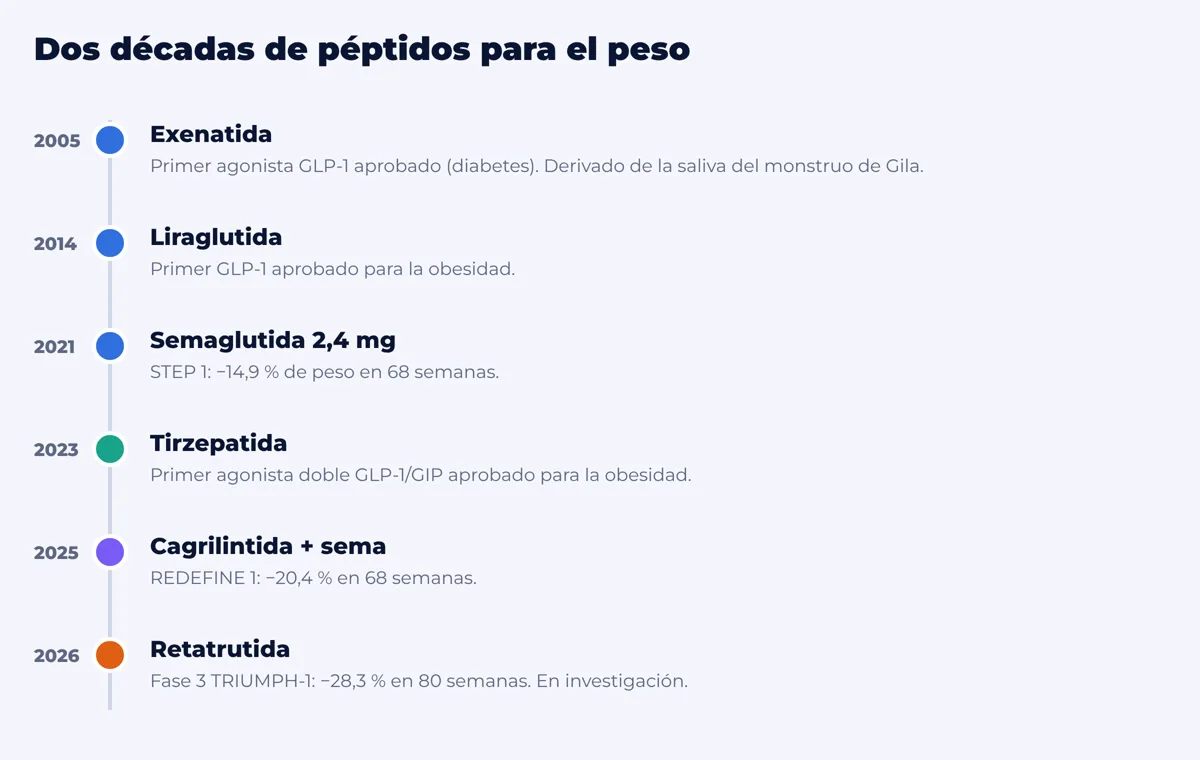
In the 1990s, researchers discovered a peptide called exendin-4 in the venom of the Gila monster, a lizard from the North American desert. It closely resembled human GLP-1, with one big advantage: the DPP-4 enzyme didn't break it down.
That led to exenatide, approved in 2005 for type 2 diabetes. The studies noticed a curious side effect: patients lost weight.
Then came liraglutide, taken daily. In 2014 it became the first GLP-1 agonist approved specifically for obesity. In its main trial, average weight loss was 8.0% at 56 weeks, versus 2.6% with placebo [5].
8% was progress. But what came next changed everything.
Chapter 4: Semaglutide, the GLP-1 agonist
Semaglutide is a once-weekly GLP-1 receptor agonist. It was the first peptide to show double-digit weight loss in a large trial.
The STEP 1 trial
Published in 2021, STEP 1 included 1,961 adults with obesity or overweight, without diabetes [1]. Half received semaglutide 2.4 mg per week and the other half placebo. Everyone also received lifestyle counseling.
Results at 68 weeks:
- Semaglutide group: −14.9% of body weight on average.
- Placebo group: −2.4%.
To put it in concrete numbers: a 100 kg person lost almost 15 kg on average.
Beyond weight: the SELECT study
Losing weight is one thing. Reducing heart attacks is another.
The SELECT study followed 17,604 adults with overweight or obesity and existing cardiovascular disease, without diabetes [2]. With semaglutide, the risk of major cardiovascular events (cardiovascular death, heart attack or stroke) was 20% lower than with placebo.
It was the first time an obesity treatment showed a reduction in cardiovascular events in a trial of this size.
Key point: semaglutide produced an average loss of nearly 15% and cut major cardiovascular events by 20% in people with existing cardiovascular disease.
Chapter 5: Tirzepatide, the dual agonist
Tirzepatide is a single molecule that activates two receptors: GLP-1 and GIP.
The SURMOUNT-1 trial
In SURMOUNT-1, 2,539 adults with obesity or overweight without diabetes received tirzepatide (5, 10 or 15 mg weekly) or placebo for 72 weeks [3].
| Group | Average loss at 72 weeks |
|---|---|
| Tirzepatide 5 mg | −15.0% |
| Tirzepatide 10 mg | −19.5% |
| Tirzepatide 15 mg | −20.9% |
| Placebo | −3.1% |
At the highest dose, more than half of participants lost at least 20% of their weight.
Head to head against semaglutide: SURMOUNT-5
Comparing different trials is always misleading. That's why SURMOUNT-5 is so valuable: it pitted the two peptides directly against each other in the same study.
It included 751 adults with obesity without diabetes, each on the maximum tolerated dose of their peptide. At 72 weeks [6]:
- Tirzepatide: −20.2%.
- Semaglutide: −13.7%.
It's the most direct confirmation that adding the GIP receptor increases the effect.
Key point: tirzepatide beat semaglutide in a head-to-head trial (−20.2% vs −13.7%), supporting the strategy of activating more than one receptor.
Chapter 6: Retatrutide, the triple agonist
If two receptors work better than one, what about three?
That's the question behind retatrutide, which activates GLP-1, GIP and glucagon.
Phase 2: the first surprise
In 2023 the phase 2 trial with 338 adults with obesity or overweight was published [4]. At 24 weeks, the highest dose already showed an average loss of 17.5%. At 48 weeks:
- Retatrutide 12 mg: −24.2%.
- Placebo: −2.1%.
In addition, the weight-loss curve had not yet flattened by the end of the study. In other words, the effect was still progressing.
Phase 3: TRIUMPH-1
In May 2026, results came out from the phase 3 TRIUMPH-1 trial, with 2,339 adults with obesity or overweight and at least one weight-related condition, without diabetes [7].
| Weekly dose | Average loss at 80 weeks |
|---|---|
| Retatrutide 4 mg | −19.0% |
| Retatrutide 9 mg | −25.9% |
| Retatrutide 12 mg | −28.3% |
In a subgroup of 532 participants with a body mass index of 35 or higher, followed to 104 weeks, loss with 12 mg reached 30.3% [7].
These are the highest figures published so far for a drug treatment for obesity.
During 2026 further phase 3 results were published, in people with type 2 diabetes and in direct comparison with semaglutide, where retatrutide also showed greater weight reductions [8].
One important detail: at the time of writing, retatrutide is still an investigational drug, not approved by the FDA [8].
Key point: retatrutide achieved an average loss of up to 28.3% in its phase 3 trial, the largest recorded, but it is not yet approved.
Chapter 7: Cagrilintide and the amylin pathway
Not all weight-loss peptides are based on gut hormones.
Amylin is a hormone the pancreas releases along with insulin. It also plays a role in satiety, but through a different pathway from GLP-1. Cagrilintide is a long-acting amylin analog.
The idea was to combine it with semaglutide, to tackle appetite on two fronts.
In the REDEFINE 1 trial, with adults with obesity or overweight without diabetes, the combination achieved at 68 weeks [9]:
- Cagrilintide + semaglutide: −20.4%.
- Placebo: −3.0%.
Key point: the amylin pathway is an alternative to GIP and glucagon agonists, and in combination with semaglutide it reached results close to 20%.
Chapter 8: Tesamorelin and other peptides mentioned online
If you search "peptides for weight loss" on social media, you'll see many more names. Some have solid evidence in a very specific context. Others have almost none in humans.
Let's go one by one.
Tesamorelin
Tesamorelin is an analog of growth hormone–releasing hormone (GHRH). It stimulates the natural release of growth hormone.
But note: it wasn't studied for general weight loss. It was studied to reduce visceral fat, the fat surrounding the abdominal organs, in people with HIV and lipodystrophy.
In that context, it reduced visceral fat by about 15% in 26 weeks, without major changes in total weight [10]. It is approved only for that indication.
MOTS-c
MOTS-c is a peptide encoded in mitochondrial DNA. In mice fed high-fat diets, it improved insulin sensitivity and prevented weight gain [11].
It's an interesting finding for metabolism research. But so far the evidence comes from cell and animal studies.
5-amino-1MQ
Technically it isn't a peptide but a small molecule. It inhibits an enzyme called NNMT, found in fat tissue. In obese mice, it reduced fat mass and the size of fat cells [12].
Again: animal data, with no published clinical trials in humans.
| Compound | Type of evidence available |
|---|---|
| Semaglutide | Large clinical trials in humans |
| Tirzepatide | Large clinical trials in humans |
| Retatrutide | Phase 2 and phase 3 trials in humans |
| Cagrilintide + semaglutide | Phase 3 trials in humans |
| Tesamorelin | Human trials, only for visceral fat in HIV |
| MOTS-c | Mainly animal studies |
| 5-amino-1MQ | Mainly animal studies |
Key point: a compound showing up on lists of "weight-loss peptides" doesn't mean it has human trials. Always check what kind of evidence backs it.
Chapter 9: The results, side by side
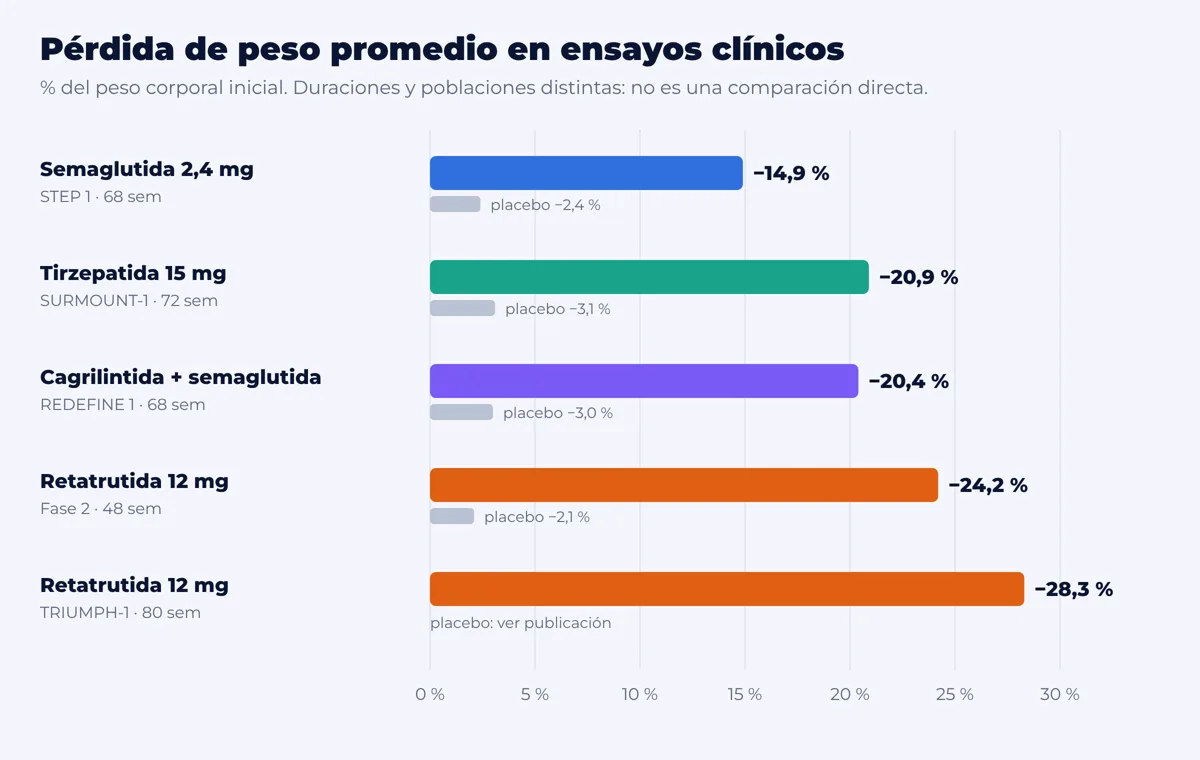
This chart summarizes the main results. Before reading it, three caveats:
- Durations differ. 48, 68, 72 and 80 weeks are not directly comparable.
- Populations differ. Starting weight and related conditions vary from one study to another.
- These are averages. In every trial some people lost much more and others much less.
The only truly direct comparison is SURMOUNT-5, where tirzepatide and semaglutide went head to head in the same study (chapter 5).
Chapter 10: Side effects
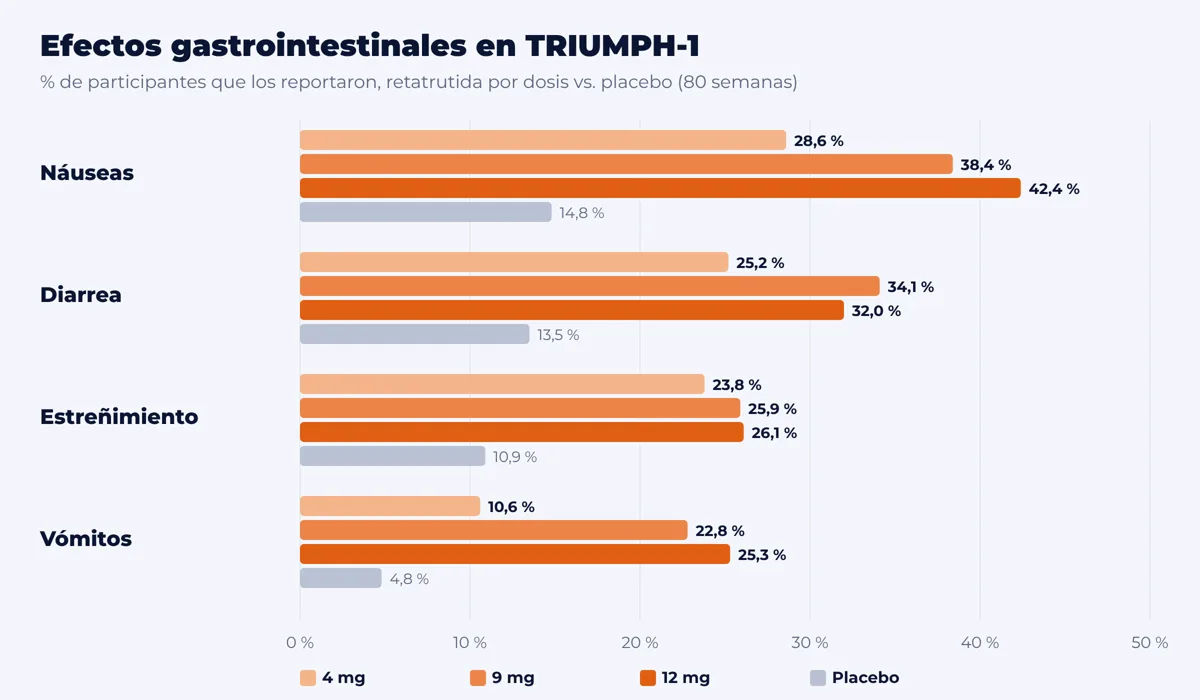
No summary of these peptides is complete without discussing their side effects.
The most common: gastrointestinal
Across all trials, the most common effects were nausea, diarrhea, constipation and vomiting. They tend to appear at the start of treatment or when the dose is increased, and in most cases they were mild or moderate.
In TRIUMPH-1, with the 12 mg dose of retatrutide [7]:
- Nausea: 42.4% (placebo: 14.8%).
- Diarrhea: 32.0% (placebo: 13.5%).
- Constipation: 26.1% (placebo: 10.9%).
- Vomiting: 25.3% (placebo: 4.8%).
Discontinuation due to side effects was 11.3% with 12 mg, versus 4.9% with placebo. In REDEFINE 1, gastrointestinal events affected 80% of the cagrilintide plus semaglutide group, versus 40% with placebo [9].
Less common but more serious
The prescribing information and trials for this class describe other risks that are closely monitored:
- Pancreatitis (inflammation of the pancreas).
- Gallbladder problems, such as gallstones, partly related to rapid weight loss.
- Thyroid C-cell tumors in rodents. These were seen in animal studies; it has not been confirmed in humans, but as a precaution these medicines are not recommended for people with a history of certain thyroid cancers.
Loss of muscle mass
When you lose weight, not everything lost is fat. In a STEP 1 substudy using DEXA scans, about 40% of the weight lost was lean mass, which includes muscle [1].
That's why specialists stress that physical activity, especially strength training, and adequate protein intake remain important during any significant weight loss.
Key point: gastrointestinal effects are common and increase with dose. There are also less common but serious risks, and a significant part of the weight lost can be lean mass.
Chapter 11: What happens when treatment is stopped
This is probably the most important question in the whole guide. And the least discussed on social media.
Two trials answered it directly.
STEP 1: one year after stopping semaglutide
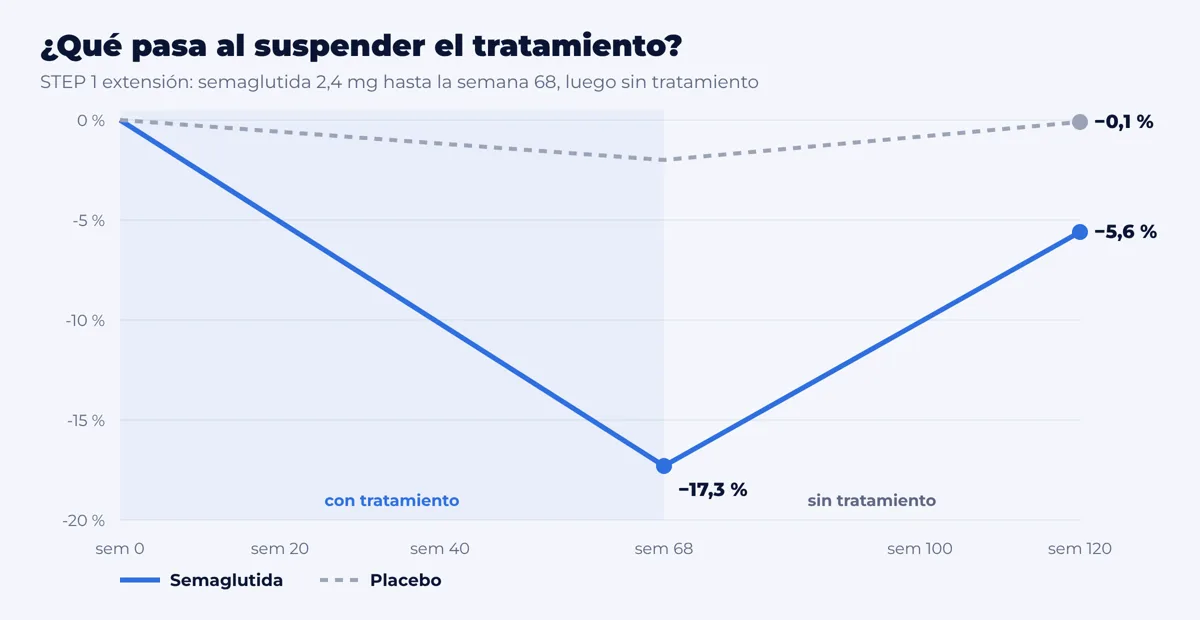
In the STEP 1 extension, participants who had lost an average of 17.3% of their weight stopped semaglutide at week 68 [13].
A year later, they had regained 11.6 percentage points. Net loss from baseline was just 5.6%.
And it wasn't just the weight: blood pressure, cholesterol and other markers that had improved also moved back toward their starting values.
SURMOUNT-4: continuing versus stopping
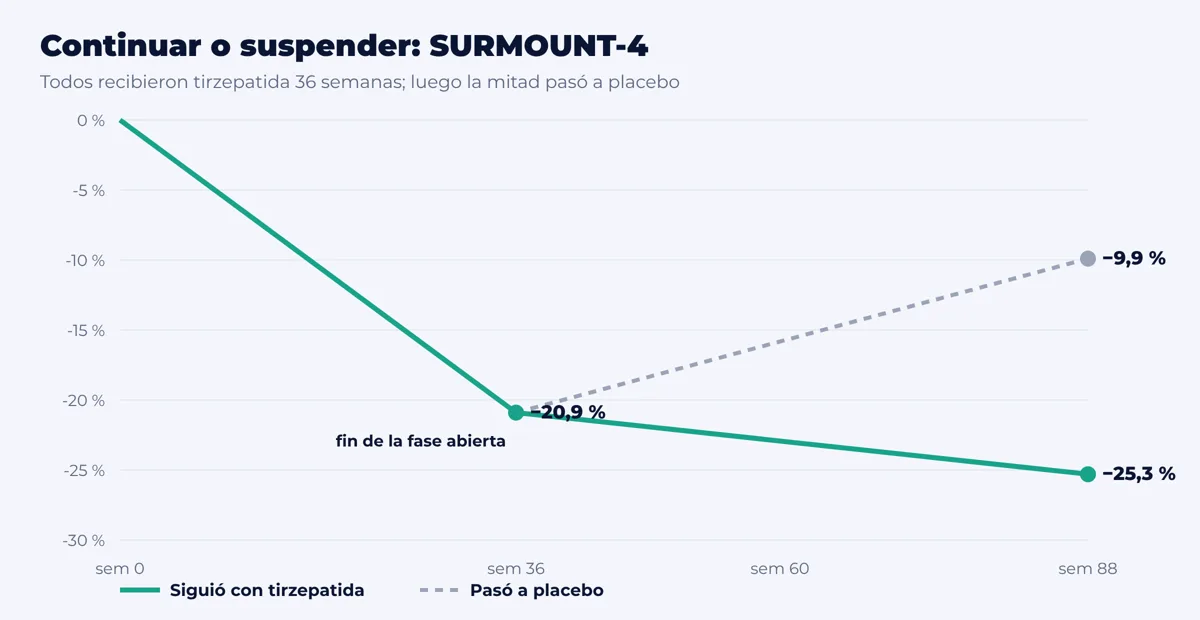
SURMOUNT-4 designed the experiment even more clearly [14]. All participants received tirzepatide for 36 weeks and lost an average of 20.9%. Then half continued on tirzepatide and the other half switched to placebo.
From week 36 to 88:
- Those who continued lost another 5.5%.
- Those switched to placebo regained 14.0%.
In the end, the group that continued had a cumulative loss of 25.3%; the group that stopped, 9.9%.
Key point: in both trials, stopping treatment led to regaining much of the weight lost. That's why most specialists consider obesity a chronic condition that requires sustained treatment.
Chapter 12: Approved medicines and research peptides
This chapter is short, but important.
When people talk about "weight-loss peptides", they are actually mixing three very different things:
- Approved medicines. Manufactured under pharmaceutical standards, with doses studied in clinical trials, a prescription and medical follow-up.
- Investigational drugs. Like retatrutide, which have clinical trials but are not yet approved.
- Peptides sold as research material. Products intended for laboratories, which are not approved or intended for human use.
The U.S. FDA has publicly warned about the risks of unapproved GLP-1 products, including dosing errors and products of questionable quality or identity [15].
For any decision about weight treatment, the recommendation is always the same: consult a healthcare professional.
Chapter 13: The future of research
The field is moving at an unusual pace. These are some of the lines being followed most closely.
Oral molecules
Not all of the future lies in injections. Orforglipron is a GLP-1 receptor agonist taken by mouth once a day. Technically it isn't a peptide but a small molecule.
In the ATTAIN-1 trial, the highest dose produced a loss of up to 12.4% at 72 weeks [16], and in April 2026 the FDA approved it for chronic weight management [17].
More receptors, new combinations
The results of retatrutide and the amylin combination suggest that activating several pathways at once is the path most developments are following. New combinations and molecules with different receptor profiles are being studied.
Preserving muscle
With weight losses of up to 30%, the quality of what is lost becomes as important as the quantity. Several lines of research aim to combine these peptides with strategies that protect muscle mass.
The questions that remain open
- What is the very long-term safety of dual and triple agonists, beyond the two or three years of the trials?
- Can weight be maintained with lower doses or a gradual taper, instead of stopping completely?
- What is the exact role of GIP and glucagon, and why do they enhance the effect of GLP-1?
- Which people respond best to each type of peptide?
Conclusion
In less than twenty years, peptides based on gut hormones went from a finding in a lizard's saliva to clinical trials with weight losses close to 30%.
What the studies show is clear:
- Activating more receptors (GLP-1, GIP, glucagon, amylin) has produced increasingly greater weight loss.
- The most common side effects are gastrointestinal and increase with dose.
- Weight tends to come back when treatment is stopped.
- Several compounds circulating online have evidence only in animals.
Research keeps advancing, and what is published in the coming years will answer many of the questions that remain open today.
This article is for informational and educational purposes. It summarizes published research results and does not constitute medical advice or a recommendation to use any product.
References
- Wilding JPH, Batterham RL, Calanna S, et al. Once-weekly semaglutide in adults with overweight or obesity (STEP 1). N Engl J Med. 2021;384:989-1002. doi:10.1056/NEJMoa2032183
- Lincoff AM, Brown-Frandsen K, Colhoun HM, et al. Semaglutide and cardiovascular outcomes in obesity without diabetes (SELECT). N Engl J Med. 2023;389:2221-2232. doi:10.1056/NEJMoa2307563
- Jastreboff AM, Aronne LJ, Ahmad NN, et al. Tirzepatide once weekly for the treatment of obesity (SURMOUNT-1). N Engl J Med. 2022;387:205-216. doi:10.1056/NEJMoa2206038
- Jastreboff AM, Kaplan LM, Frías JP, et al. Triple-hormone-receptor agonist retatrutide for obesity — a phase 2 trial. N Engl J Med. 2023;389:514-526. doi:10.1056/NEJMoa2301972
- Pi-Sunyer X, Astrup A, Fujioka K, et al. A randomized, controlled trial of 3.0 mg of liraglutide in weight management (SCALE). N Engl J Med. 2015;373:11-22. doi:10.1056/NEJMoa1411892
- Aronne LJ, Horn DB, le Roux CW, et al. Tirzepatide as compared with semaglutide for the treatment of obesity (SURMOUNT-5). N Engl J Med. 2025;393:26-36. doi:10.1056/NEJMoa2416394
- Retatrutide achieves up to 30.3% average weight loss in phase 3 TRIUMPH-1 trial. AJMC. May 21, 2026. https://ajmc.com/view/retatrutide-achieves-up-to-30-3-average-weight-loss-in-phase-3-triumph-1-trial
- Retatrutide: development and FDA approval history. Drugs.com. https://www.drugs.com/history/retatrutide
- Garvey WT, Blüher M, Osorto Contreras CK, et al. Coadministered cagrilintide and semaglutide in adults with overweight or obesity (REDEFINE 1). N Engl J Med. 2025. doi:10.1056/NEJMoa2502081
- Falutz J, Allas S, Blot K, et al. Metabolic effects of a growth hormone–releasing factor in patients with HIV. N Engl J Med. 2007;357:2359-2370. doi:10.1056/NEJMoa072375
- Lee C, Zeng J, Drew BG, et al. The mitochondrial-derived peptide MOTS-c promotes metabolic homeostasis and reduces obesity and insulin resistance. Cell Metab. 2015;21:443-454. doi:10.1016/j.cmet.2015.02.009
- Neelakantan H, Vance V, Wetzel MD, et al. Selective and membrane-permeable small molecule inhibitors of nicotinamide N-methyltransferase reverse high fat diet-induced obesity in mice. Biochem Pharmacol. 2018;147:141-152. doi:10.1016/j.bcp.2017.11.007
- Wilding JPH, Batterham RL, Davies M, et al. Weight regain and cardiometabolic effects after withdrawal of semaglutide: the STEP 1 trial extension. Diabetes Obes Metab. 2022;24:1553-1564. doi:10.1111/dom.14725
- Aronne LJ, Sattar N, Horn DB, et al. Continued treatment with tirzepatide for maintenance of weight reduction in adults with obesity: the SURMOUNT-4 randomized clinical trial. JAMA. 2024;331:38-48. doi:10.1001/jama.2023.24945
- U.S. Food and Drug Administration. FDA's concerns with unapproved GLP-1 drugs used for weight loss. https://www.fda.gov/drugs/postmarket-drug-safety-information-patients-and-providers/fdas-concerns-unapproved-glp-1-drugs-used-weight-loss
- Wharton S, et al. Orforglipron, an oral small-molecule GLP-1 receptor agonist for obesity treatment (ATTAIN-1). N Engl J Med. 2025. doi:10.1056/NEJMoa2511774
- FDA approves orforglipron, an oral GLP-1, for adults with obesity. Healio. April 1, 2026. https://www.healio.com/news/endocrinology/20260401/fda-approves-orforglipron-an-oral-glp1-for-adults-with-obesity
For laboratory research only. This article is educational and is not medical advice. We don't provide dosing or treatment guidance.