
 Free BAC Waterwith every order
Copper & dermatological
Glutathione
★★★★★5.0 Google · 4.6 TrustpilotIn stock
₡191,365₡225,135Save ₡33,770
5 × ₡45,027 · 15% bulk discount · + free BAC Water
Strength 1 option
Quantity Best discount applies automatically
Custom quantity
Add 5 more to save 20% (₡90,054)
COA on most productsPay cash on delivery2–4 day delivery
Frequently ordered together
Bundle total
₡54,032
₡54,032
Specifications
FormLyophilized powder
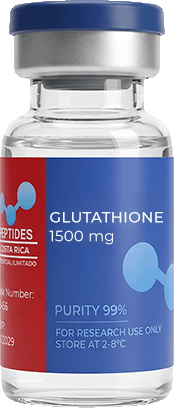
Strengths1500 mg
CategoryCopper & dermatological
Storage2–8 °C, away from light
TypeTripeptide (γ-Glu-Cys-Gly), reduced form
Molecular formulaC₁₀H₁₇N₃O₆S
Molecular weight307.32 g/mol
CAS70-18-8
Questions
The compound and amount on the label, as lyophilized powder (or ready-to-use liquid for blends and waters). Most products have a Certificate of Analysis confirming identity and purity.
2–4 business days anywhere in Costa Rica, tracked, from our own cold storage. No customs or import fees.
SINPE Móvil, bank transfer, card, or cash when it arrives.
15% off 5+ vials of the same product, 20% off 10+. The best discount applies automatically. Every order includes a free BAC Water 3 ml, and delivery is free over ₡90,054.
No. All products are for laboratory research use only. We don't provide dosing or medical advice.
Why order from us
scienceThird-party testedCOA on most products
ac_unitCold storage on site2–8 °C until dispatch
local_shipping2–4 day deliveryLocal stock, no customs
autorenewReplacement promiseDamaged or off-batch? Replaced
What people say
 ★★★★★
Excellent service, quality, and price. For me, they are the best in Costa Rica; I hope they never change.
Daniel Manzanares Quesada · Trustpilot
★★★★★Hay stock y son rápidos y asesoran muy bien, confiable los pagos y el producto llega en buen estado.
Botanical Cosmetic · Trustpilot
 ★★★★★
Son excelentes, mil estrellas.
Lic. Juan Alfonso Mata Chavarría · Google
More in Copper & dermatological
Research use only. Supplied for laboratory research. Not for human or veterinary use. We do not provide dosing or medical advice.
Studies
What Glutathione Is and How It Is Studied An Unusual Tripeptide Glutathione is three residues — glutamate, cysteine, glycine — but the first bond is a gamma linkage off the glutamate side chain rather than a standard alpha peptide bond. That single structural difference is what makes the molecule stable enough to accumulate intracellularly at millimolar concentrations, and it is why glutathione cannot be made by the ribosome like an ordinary peptide. How It Is Synthesised Two ATP-dependent enzymes build it. Glutamate-cysteine ligase joins the first two residues and is the rate-limiting step, controlled by feedback inhibition from the finished product. Glutathione synthetase adds the glycine. Both steps happen in the cytosol, and cysteine availability is generally the limiting input. The Redox Couple The free thiol on the cysteine residue is the reactive part. Two glutathione molecules oxidise to a disulfide-linked dimer, GSSG, and glutathione reductase converts them back using NADPH. The ratio of reduced to oxidised form is one of the standard measures of cellular redox state, and glutathione peroxidases and S-transferases use the reduced form as their substrate. The Bioavailability Problem Worth stating plainly, because most vendor copy skips it. Administered glutathione is rapidly broken down by gamma-glutamyl transpeptidase on cell surfaces, and whether intact molecules reach the intracellular pool in any meaningful quantity has been contested for decades. The enzyme that degrades it is the same gamma linkage specialist that makes the molecule interesting in the first place.
Why Choose Peptides Costa Rica’s Glutathione Peptides?
We specialize in supplying high-purity research peptides with a focus on transparency, fast domestic delivery, and dedicated customer support.
scienceThird-Party Lab Tested All Peptides Costa Rica products are independently tested for purity, identity, and quality. Each batch is reviewed for peptide integrity, purity levels, and contaminants, with a COA included.
historyResearch-Grade Peptides Peptides Costa Rica supplies research-grade peptides made under strict quality-control standards. Products are synthesized for high purity & provided in stable lyophilized form for laboratory research.
lab_profileTrusted Peptide Supplier Peptides Costa Rica focuses on transparent sourcing, verified testing, and consistent product quality. Researchers rely on our peptide collections for dependable products, service & support.
Glutathione Research Overview
Glutathione was first described more than a century ago. Frederick Gowland Hopkins isolated and named it in 1921, building on an earlier observation by de Rey-Pailhade in 1888, and its central place in cell biology has not been in question since.
It is present in most cells at millimolar concentration, higher than almost any other small-molecule thiol, and the ratio between its reduced and oxidised forms is a standard laboratory readout for redox state. Glutathione peroxidases use it to reduce peroxides; glutathione S-transferases conjugate it to electrophilic compounds, which is the first step of the mercapturic acid pathway.
Those roles are textbook biochemistry and are not disputed. What is disputed is what happens when the molecule is administered from outside rather than synthesised inside the cell.
Gamma-glutamyl transpeptidase cleaves extracellular glutathione rapidly, and the question of whether administered glutathione raises intracellular levels, or simply supplies its constituent amino acids for resynthesis, has been argued in the literature for decades without resolution.
That unresolved question underlies every claim about glutathione as an administered compound, and it is why we describe the molecule’s biochemistry rather than its reported effects here.
Get In Touch
Have questions about Glutathione products or research-use details? Our team can help you review available options, product information, storage guidance, and ordering details.
Why Researchers Choose Glutathione
A defined tripeptide with settled specifications, supplied at the lowest per-milligram cost in the catalogue.
scienceDefined Structureγ-Glu-Cys-Gly, C10H17N3O6S, molecular weight 307.32, CAS 70-18-8.
historyConfirmable IdentityOne sequence, one molecular weight — mass spectrometry gives an unambiguous result.
lab_profileHigh Mass Per Vial1500mg per vial, the largest single-compound vial in the catalogue
inventoryReliable SupplyConsistent availability with fast delivery across Costa Rica.
Trusted Source for Research Peptides
We supply high-purity Glutathione and other research compounds with consistent quality, transparent pricing, and reliable local delivery. Every order ships from inside Costa Rica — no customs delays, no import duties.
scienceBulk SavingsSave more with bulk purchases. Buy five or more vials of the same product and get 15% off with clear, upfront pricing and no hidden conditions.
historySimple Ordering ProcessPlace orders through a simple process—review products, confirm availability, choose your payment method, and arrange delivery within Costa Rica.
lab_profileFlexible Payment OptionsChoose from secure payment options including SINPE Móvil, Zelle, or cash for smooth and convenient transactions.
inventoryTransparency & DocumentationWe provide Certificates of Analysis along with clear communication, verified stock, and straightforward pricing for complete trust.
How to order
- 1ChoosePick the strength and quantity. Bulk discounts apply automatically.
- 2CheckoutPay by card, or send the order on WhatsApp for SINPE, transfer or cash on delivery.
- 3ReceiveDelivered in 2–4 days with your batch COA.
Glutathione FAQ
A tripeptide, γ-L-glutamyl-L-cysteinylglycine, built from glutamate, cysteine and glycine. Molecular formula C10H17N3O6S, molecular weight 307.32, CAS 70-18-8. It is unusual among peptides because the first bond is a gamma linkage from the glutamate side chain rather than a standard alpha peptide bond, which is why it resists ordinary peptidases and is synthesised enzymatically rather than on a ribosome. Supplied as a lyophilised powder in 1500mg vials for laboratory use.
Different classes of molecule. Glutathione is a tripeptide with a free thiol, and its reduced-to-oxidised ratio is a standard measure of cellular redox state. NAD+ is a dinucleotide coenzyme that carries electrons in redox reactions and is consumed as a substrate by sirtuins and PARP enzymes. Both are central to cell biology and neither is interchangeable with the other. See the NAD+ page for its specifications.
Structurally and by class. Glutathione is γ-Glu-Cys-Gly, a three-residue peptide with an unusual gamma linkage and no metal. GHK-Cu is the tripeptide glycyl-L-histidyl-L-lysine complexed with a copper(II) ion — the copper is part of the product. They share a residue count and nothing else.
It is the principal intracellular thiol, present at millimolar concentration in most cells. Glutathione peroxidases use it to reduce peroxides. Glutathione S-transferases conjugate it to electrophilic compounds as the first step of the mercapturic acid pathway. Glutathione reductase regenerates the reduced form using NADPH. The ratio of reduced to oxidised glutathione is a standard laboratory readout for redox state.
Store unreconstituted vials refrigerated at 2–8°C in lyophilised form; freeze for long-term storage. In solution glutathione oxidises readily on exposure to air and light, so keep any solution refrigerated, sealed and dark. Avoid repeated freeze-thaw cycles. Keep vials sealed until use. Material is non-sterile.
Orders inside Costa Rica are typically delivered within 2–4 business days. You'll receive tracking once shipped — no customs delays or import fees since everything is fulfilled domestically.
No. We supply material and documentation. We do not provide dosing guidance, administration routes or frequencies, reconstitution media or volumes, protocols or cycles, and we do not refer enquirers elsewhere for them. Questions about batch paperwork, specifications and certificates are welcome.